
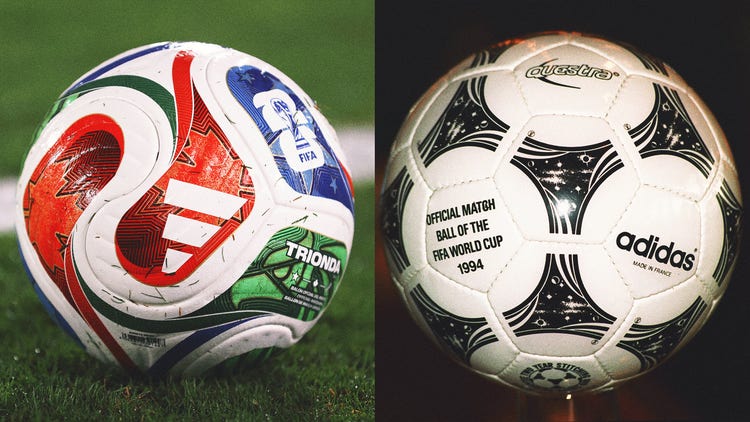
The beauty of each World Cup is the attention to detail and how each edition weaves in the traditions and characteristics of the host nations.
And that’s especially true with the official match ball. Take for instance the recently released TRIONDA ball, which all eyes will be on next year at the 2026 FIFA World Cup, which will be hosted in three nations – Canada, Mexico, and the United States.
Since 1970, adidas has supplied the official match ball for the World Cup. Before then, the match balls were provided by manufacturers from the host countries. Get a low down on each ball from 1930.
Let’s take a deeper dive into each ball, including how they got their names and what made them stood out.
2022 – Al Rihla (Qatar)
(Getty Images)
Meaning “The Journey” in Arabic, Al Rihla included 20 panels and featured a suspended chip inside the ball that tracked in-game data. Its design drew inspiration from Qatari culture and maritime traditions, with the bonded bails hearkening to the Dhow boats found in the Persian Gulf waters. It also was the first official ball produced entirely with water-based inks.
2018 – Telstar 18 (Russia)
(Getty Images)
The Brazuca (the name was decided by a public vote) was made from six bonded panels and was inspired by Bahia lembrança bands, the traditional Brazilian good luck bracelets composed as colorful pieces of cloth and given as gifts. A special version was used in the final with the green, red and blue accents replaced by green, gold and black.
2010 – Jabulani (South Africa)
(Getty Images)
The ball (German for “team spirit”) revolutionized ball construction with just 14 curved panels, creating a rounder, more seamless surface for consistency. Its white design with black-and-gold accents fit the host nation’s aesthetic. It was the first ball to have a different version used for the knockout stages.
2002 – Fevernova (Japan/South Korea)
(Getty Images)
The first multicolored World Cup ball, Tricolore integrated France’s national blue, white, and red. It also symbolized modernity, national pride, and a willingness to depart from traditional monochrome styles. It was also the last of the “Tango” designs that had been in use for the World Cup since 1978.
1994 – Questra (United States)
(Getty Images)
The first ball with an internal layer of black polyurethane foam for greater responsiveness and durability. Its design paid homage to Italy’s Etruscan history, featuring lions’ heads in classical motifs across its 20 triangular panels.
1986 – Azteca (Mexico)
(Getty Images)
Building on 1978’s Tango, the España featured stronger waterproofing and polyurethane coating, enhancing performance in variable Spanish conditions. It was also the last ball to be fully leather before synthetic materials became the norm.
1978 – Tango (Argentina)
(Getty Images)
The Durlast featured a new coating to protect against water absorption. The design remained black-and-white for visibility on TV and marked a leap forward in ball technology from the tournament four years prior.
1970 – Telstar (Mexico)
(Getty Images)
Made by Slazenger, this 25-panel hand-stitched leather ball had no laces with a bright orange version used for visibility on television and for the final. It utilized a latex valve and was selected by tournament officials in a blind test before the tournament.
1962 – Crack (Chile)
(Getty Images)
Selected from over 100 submissions, the Top Star (made by machine manufacturer Sydlader AB) was made of high-grade leather with 18 panels and no laces. Its consistent bounce and lighter feel allowed for faster, more precise play – fitting the tournament that introduced Pelé to the world. But France forward Just Fontaine is more synonymous with this ball, having scored 13 goals in six matches, a record for a single tournament that still stands.
1954 – Swiss World Champion (Switzerland)
(Getty Images)
The return of the World Cup tournament after 12 years of war featured a ball that had 12 hand-stitched panels – but introduced hidden laces with a rubber valve that could be inflated with a single hand pump. It was the first World Cup ball that did not require reinflation through an external seam during play.
1938 – Allen (France)
(Getty Images)
The Italian ECAS (Ente Centrale Approvvigionamento Sportivi, the government’s bureau for sport supplies) produced the ball that had 12 hand-stitched leather panels with visible laces. It also marked FIFA’s first standardized World Cup ball. The laces were made of softer material to make them lighter and more manageable, especially for headers.
1930 – Tiento/T-Model (Uruguay)
(Photo by KARIM JAAFAR/AFP via Getty Images)