

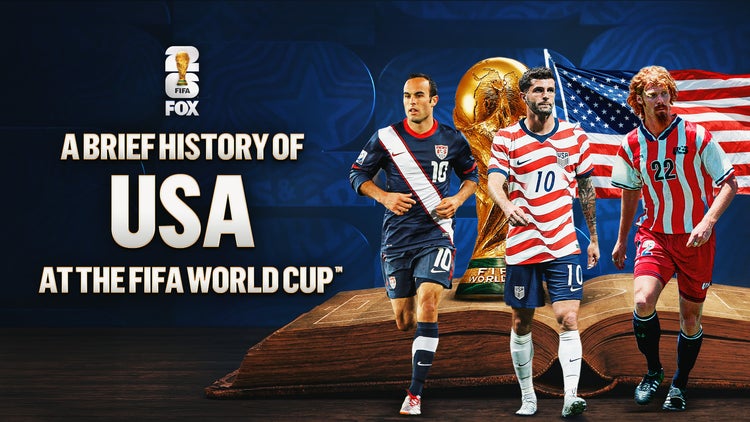
The United States men’s national team is primed to deliver in front of home crowds as co-hosts of the 2026 FIFA World Cup. But it’s been a unique journey for the team since its first appearance at the inaugural World Cup in 1930. Here’s a brief history of the evolution of the U.S. men’s national team.
Although a team representing the U.S. played a Canadian team in 1885 in Kearney, New Jersey, it would be decades before the U.S. men’s national team was officially recognized. That included the 1904 Olympics in St. Louis, where two clubs — Christian Brothers College and St. Rose Parish — would win silver and bronze medals.
The United States Soccer Federation was founded in April 1913. The U.S. men’s team played its first official international match in Stockholm against Sweden in August 1916, winning 3-2. That game was part of a six-match tour in Sweden and Norway.
In 1930, the United States, along with 12 other international football teams, played the inaugural World Cup in Uruguay. The first experience for the U.S. at the World Cup exceeded any expectations as the Stars and Stripes actually finished third.
After a half‑hearted qualifying process (only Mexico and the U.S. bothered to enter from North America), the Americans traveled to Uruguay with a ragtag squad of semi‑pros, British immigrants, and one Belgian‑born goalkeeper.
The U.S. stunned Belgium 3‑0 in its opening match, then routed Paraguay 3‑0 to win the group. In the semifinal, however, the U.S. ran into Argentina, sustaining a 6‑1 defeat. Argentina would then lose to the host country, 3-2, in the first ever final.
No third‑place match was played, but FIFA retroactively awarded the U.S. bronze based on overall record.
(Photo by EMPICS Sport/EMPICS via Getty Images)
The 1950 World Cup featured one of the great upsets in history. Powered by a 37th minute goal from Joe Gaetjens, the U.S. beat a heavily favored England squad 1-0 in Belo Horizonte, Brazil. The game even earned the nickname “The Miracle Match” and was subject to books and even a 2005 movie called “The Game of Their Lives.”
Much like the USA’s 1930 World Cup team, the squad consisted of part-time players that held jobs such as a grave digger and a postman. Even Gaetjens, who was not yet a U.S. citizen when he was selected to the team, was a dishwasher living in New York. On the other hand, England featured professional players in their debut World Cup appearance.
Despite the win, the U.S. failed to advance past the first round, but they made a statement the nation could remember as it then endured a 40-year World Cup drought.
Italian defender Paolo Maldini is tackled by USA midfielder Paul Caliguri during the 1990 World Cup (BOB PEARSON/AFP via Getty Images)
The tides began to turn in the 1990s, highlighted by the 1994 World Cup hosted stateside. While many expected empty stadiums in a country that prioritized other sports, that was far from the reality. More than 3.5 million fans flocked to matches around the nation — still a World Cup record.
Led by several veterans of the 1990 squad and newcomers such as Alexi Lalas and Cobi Jones, the USA delivered on the pitch, too, advancing past the group stages for the first time in 64 years. Ultimately, it lost 1-0 to eventual champions, Brazil, in the round of 16. That result proved the U.S. could compete with giants of the soccer world.
The 1994 World Cup led to the birth of Major League Soccer two years later, which increased the talent pool available domestically and provided academies for the nation’s youth.
Landon Donovan broke through at the 2002 World Cup. (Photo by Henri Szwarc/Bongarts/Getty Images)