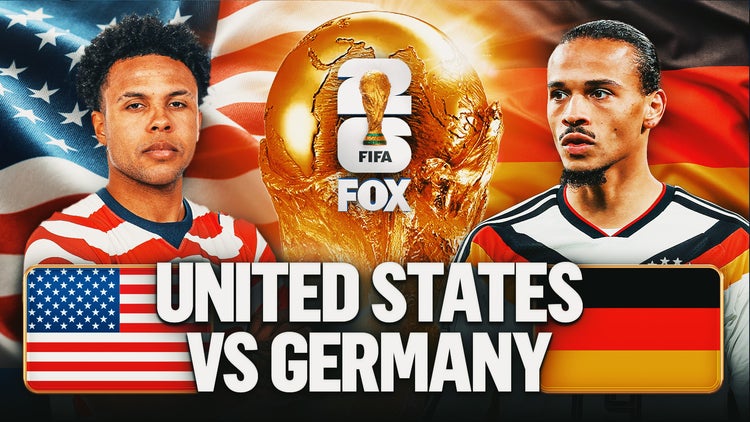
I’ve played in a World Cup and understand how the U.S. national team is preparing — and what matters most. There’s one more game until the Americans’ tournament is underway against Paraguay on June 12, and it’s important to go in with confidence.
This time around, I have a different challenge. I’ll be breaking down the USA throughout its journey through the 2026 World Cup, starting with a final tune-up game against Germany.
Here are my keys to the game and a preview of what to expect from Germany and the USA.
Winger · Germany
When looking at the German national team, the first names that come to mind are probably Jamal Musiala, Florian Wirtz or Joshua Kimmich. The player I’m watching out for in this game, though, is someone who can exploit a potential weakness in the U.S. defense.
Sane is the player I’m highlighting because it ties into what I’m worried about with the United States. The former Manchester City star is a fast, left-footed winger who generally plays on the right side. He can dribble in either direction, cut in on his left foot or drag the ball toward the touchline.
Tim Ream and Antonee “Jedi” Robinson on the left side of the U.S. defense will be defending Sane. When Robinson is high up the field and Germany gets the ball in transition, there’s a chance you’re going to have Sane against Tim in open space. After watching the friendly against Senegal, that wouldn’t be ideal for this U.S. team.
Leroy Sané will pose a unique threat to the United States defense. (Harry Langer/DeFodi Images/DeFodi via Getty Images)
This will be less of an issue in the group stage of the World Cup for the United States against Paraguay, Australia and Türkiye. As you get into the knockout rounds, though, you’re going to face players who are able to exploit that pace and potentially cause problems for Ream.
Ream will be important in controlling buildouts for the U.S. team, but in the first 20 minutes against Senegal last Saturday, he had some uncharacteristic turnovers that led to dangerous chances.
Additionally, there were a few moments when the ball went wide, and Ream wasn’t immediately close enough. He did the right thing in that situation of delaying the attack and waiting for help, but his ability to defend wingers in dangerous positions will play a vital role in the tournament.
Alex Freeman will look to build on his performance against Senegal and should find himself in more one-on-one moments out wide against Germany, as well.
Midfielder · United States
I’m curious to see how Wes plays and how much of the game he can dictate. We know how good he is in attack, but can he be effective on both sides of the ball?
Wes played the second half against Senegal after Pochettino made 10 changes at halftime. He did very well, especially defensively, showing a grit and leadership that came with wearing the captain’s armband for the second half.
Wes is expected to start in the midfield next to Tyler Adams, who can cover a lot of ground defensively and potentially give him freedom to move forward. Still, against a team like Germany that can cause problems for the U.S. quickly in transition, my former U.S. teammate has to put in a strong shift on both ends of the field.
I know he can do it, having played with the famous “MMA” midfield of Tyler, McKennie and Yunus Musah at the 2022 World Cup. Adams covered the middle of the pitch, while Wes and Yunus covered the rest of the midfield, all the way out to the sideline. This will be a good test against Germany entering the tournament.
How well McKennie plays and how much of the game the American midfield can dictate will determine what the U.S. can get out of the game.
The U.S. may need a different mentality against Germany compared with how it started against Senegal. The starting lineup played 45 minutes together before 10 substitutions at halftime. Mauricio Pochettino wants his team to press high up the field, and you’re going to empty the tank when you know you’re only going to play 45 minutes.
I was very impressed with the compactness of the team against Senegal and hope we see that again against Germany. Offensively, there were so many positive combinations and goal-scoring opportunities from the attacking group in the previous match. Let’s see if the team can continue to look dangerous against Germany.
I’d expect we’ll see more minutes from the starting XI against Germany to get the match fitness needed for the World Cup while also trying to stay safe and healthy. My assumption is for the starting XI to play at least 60 to 70 minutes in this one.
Can the U.S. be as aggressive against Germany as it was against Senegal? The Americans are unlikely to have as much of the ball as they had in their first friendly. This matchup may require them to drop into a low block, sit back and defend more.
If Pochettino starts with three center backs, as he did against Senegal, how does the U.S. drop back in defense? When they enter into a low block does it turn into a 5-4-1? Will the U.S. be content to concede space and possession? I’m curious to see how the team sets up against a potential title contender.
With that, can the U.S. find the right balance of attack and defense? Can the team say, “Hey, we’re not just going to be passive, can we go out there and be aggressive in the right moments?” Based on the Senegal game, I am expecting the Americans to at least try to be very aggressive in the first 10 or 15 minutes.
Finding that balance will take a lot of maturity from both the coaching staff and players on the pitch. I’m hopeful that we can find the right balance between pressing and sitting back against a team that will be considered a superior opponent.
I think Germany will score a goal in transition.
There are two things I’m worried about with the U.S. in the World Cup, and they both have to do with its defense. The first one, as I’ve already talked about, is how this team is going to defend in transition when the opposition is on a counterattack. Germany has players like Sane, Musiala and Wirtz — who can cause trouble when given space and time on the ball.
The other thing I’m worried about — which may not pertain to this game necessarily — is how the U.S. will be able to play against a big-target striker. Thankfully, Germany doesn’t have one of those, and defender Chris Richards would give the U.S. a different element in defense if he’s fit.
Against Senegal, some direct balls were played toward the U.S. defense that Mark McKenzie and Ream didn’t handle smoothly. The addition of Richards should help in this area, and I’m hoping we see a bit more control on that moving forward. Playing against a big striker will test this American backline both in holdup play and deep into the penalty box.