
In the world of global sports, mononyms — going by a single name — has become one of the more popular parts of the sport.
Icons like Pelé, Ronaldo, Ronaldinho, and Kaká don’t need a surname to identify themselves to the world.
But while it looks like a calculated marketing strategy for modern brands, the origin of the soccer mononym is actually rooted in deep cultural traditions, nicknames and the informal nature of soccer itself.
Raphina, Vinicius Jr, and Neymar of Brazil. (Photo by Michael Steele/Getty Images)
The phenomenon is most famously tied to Portuguese and Spanish-speaking countries, particularly Brazil. In Portuguese culture, naming conventions are exceptionally long, often combining multiple maternal and paternal family names.
For example, Pelé (born Edson Arantes do Nascimento) remains the most famous one-name soccer star. But broadcasting or printing long names on a match sheet often became impractical. To solve this, players started to use apelidos (nicknames).
Some current players who follow this trend are Brazil’s Raphinha, born Raphael Dias Belloli or Vinícius Jr, born Vinícius José Paixão de Oliveira Júnior. Another Brazilian star, Neymar, was Neymar da Silva Santos Júnior. The same goes for Spain’s Pedri, born Pedro González López, and Rodri, born Rodrigo Hernández Cascante.
In Brazil, soccer has historically been a game of the working class, played in streets and dirt lots where formal surnames carry little weight. Players are christened with nicknames by teammates, fans, or family based on physical traits, childhood stories, or where they grew up.
When younger players transition to the professional ranks, the street names stick. Ultimately, what began as a linguistic shortcut and a nickname has evolved into one of soccer’s biggest badges of honor. A single name connects an athlete with the fan, turning a player into a household name.
A few famous examples of players going by a single name include:
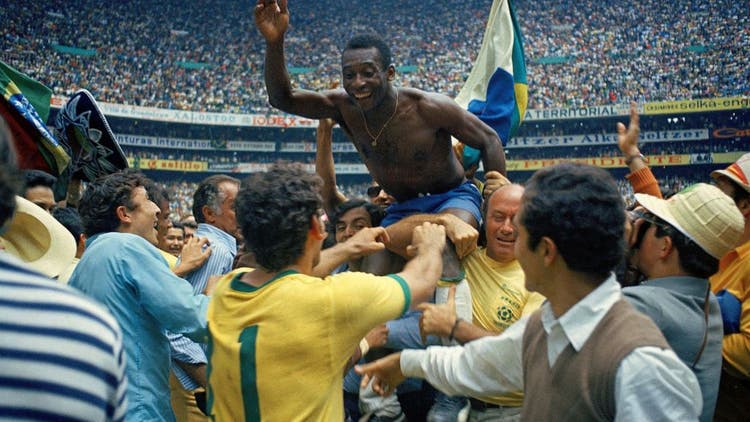
Pelé wears a crown and holds a scepter as Brazil are crowned champions at the 1970 FIFA World Cup in Mexico. (Photo by 4Imagens/Getty Images)
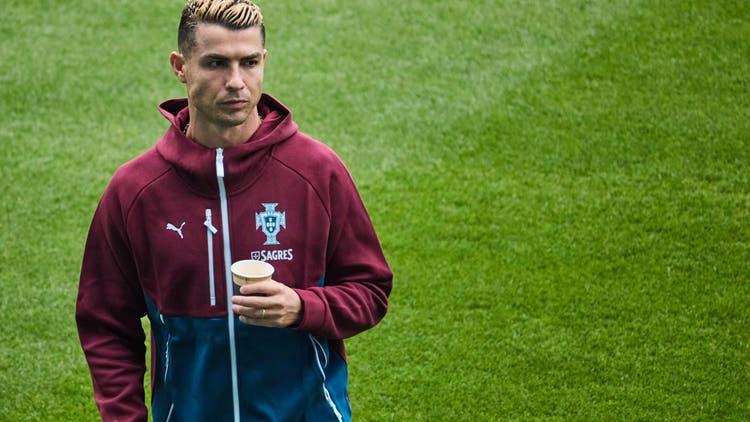
The name Ronaldo is very come in Portuguese-speaking countries (Lusophone countries to be precise). You’d be forgiven then if it was slightly confusing when referring to two legendary figures from Brazil. Ronaldinho – whose full name is Ronaldo de Assis Moreira – means “Little Ronaldo,” adopted to distinguish him from older teammate and fellow icon, Ronaldo (whose full name is Ronaldo Luís Nazário de Lima).
Of course, Ronaldo went by “Ronaldinho” for a short time as well during his early playing days. And that’s not even to mention Portugal’s Cristiano Ronaldo, who is often referred to by one name as well.
Kaká – born Ricardo Izecson dos Santos Leite – earned his apelido from his younger brother’s inability to pronounce “Ricardo.” The Brazilian was also often referred to by “Ricardo Kaká” during is playing days, combining his real name and his more famous moniker.
Pedri will be one of Spain’s stars at the 2026 World Cup. (Photo by Diego Souto/Getty Images)