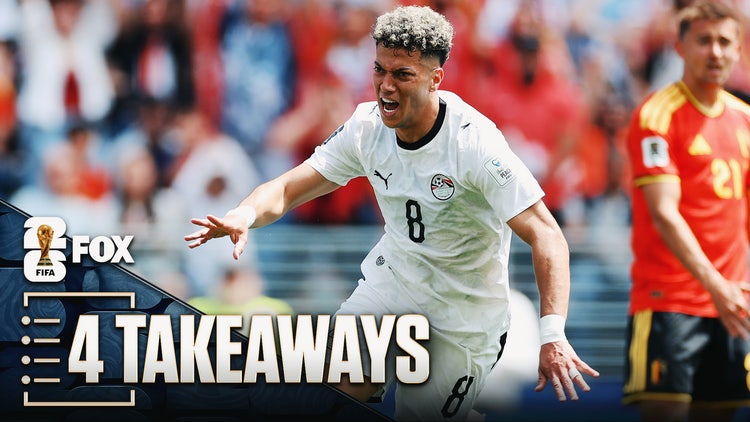
Belgium’s golden generation might have ended in 2022, but a younger squad opened its World Cup the way it has opened most things lately: with more questions than answers. Egypt — organized, patient, entirely unfazed by the badge they were facing — held one of Europe’s more talented squads to a 1-1 draw in Seattle.
Emam Ashour put the Pharaohs ahead in the 19th minute. Belgium, who lined up without a recognized striker, spent an hour passing the ball to death without ever threatening to score one. Then Rudi Garcia went for one of the lasting remnants of the past Golden generation, and that man shocked audiences with his first touch.
Here are my takeaways from Belgium’s opening draw:
(Photo by Dale MacMillan/Soccrates/Getty Images)
Belgium started this World Cup match without a striker.
Garcia deployed Charles De Ketelaere, usually a second striker or attacking midfielder, as a false nine in front of an attacking midfield three built on flair: Jérémy Doku, Kevin De Bruyne, Leandro Trossard. It produced some decent football but virtually no penalty-box menace. Egypt’s block sat there and dared Belgium to find a center forward. Belgium couldn’t muster a single shot on target during the entire first half.
Enter Romelu Lukaku. Within seconds, a Youri Tielemans pass sprang Thomas Meunier down the right. Lukaku’s run through the middle was perfectly timed as the low cross was fed right into the path of the veteran striker.
That sequence is Belgium’s entire striker situation in a nutshell. Lukaku is 33. He has played about an hour of competitive football all season after a high-grade thigh tear, surgery and a parade of setbacks at Napoli — a saga ugly enough that he spent half the year rehabbing in Belgium against his club’s wishes. And he is still, comfortably, the most important No. 9 this team has. Belgium’s all-time leading scorer, and it isn’t close.
The question for Garcia was never whether Lukaku belongs. It depends on whether his body allows him to be the player this squad is designed around.
(Photo by Sarah Stier – FIFA/FIFA via Getty Images)
Two goals allowed in ten qualifying matches is not a rounding error. It’s an identity.
Hassan has built a side around defensive discipline and two attackers who can punish a single lapse. Salah — who turned 34 on Monday, and is fresh off a quieter final season at Liverpool — is still feared by defenders. Marmoush, now at Manchester City, offers a second runner who threatens in behind the moment a center back steps too high. Ashour’s opener came from exactly the kind of organized, low-risk football this team will live on.
The draw has been kind to the Pharaohs, too. They drew the toughest fixture first and came away with a point. Iran and New Zealand are next, and Egypt will fancy itself in both. Second place in Group G is very much on the table — and a Round-of-32 date that could fall against the United States is the sort of thing that makes a federation dream.
We have been writing this group’s obituary since 2018, and it keeps refusing to die quietly. De Bruyne is 34. Courtois is 34. Lukaku is 33 and held together with tape. The trophy cabinet is empty. Qatar 2022 ended in a group-stage exit and a dressing room reportedly at war with itself. The brief in 2026 was simple: don’t do that again.
A point against a well-drilled Egypt is not that. But in a draw, Garcia’s headline idea—De Bruyne conducting behind a strikerless front three—generated barely any threat. It’s the kind of result that should keep a coach up at night. The talent has never been the issue with Belgium. The coherence has.
Iran comes next in Los Angeles, then New Zealand in Vancouver. Both are winnable. Both are also precisely the sort of stubborn, well-organized opponent that just gave Belgium 90 minutes of frustration while wearing a different shirt. Garcia has a week to decide how much he trusts Lukaku’s body — because for an hour on Monday, the alternative looked like nothing at all.