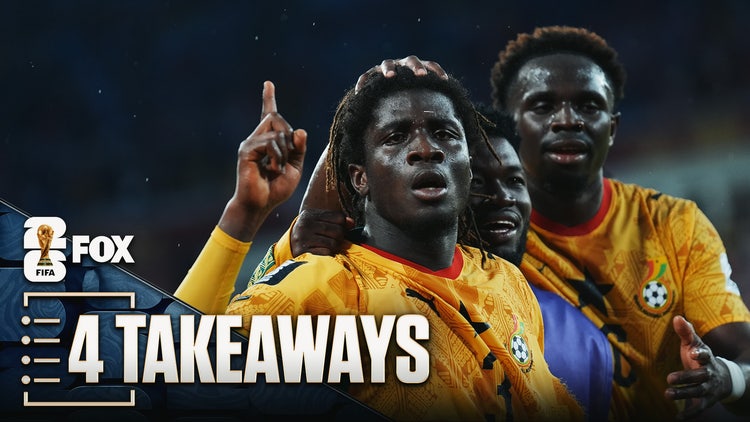
For over 90 minutes, Ghana and Panama appeared to be heading to a dull scoreless draw. But deep into stoppage time, Caleb Yirenkyi got on the end of a brilliant counterattack led by Brandon Thomas-Asante to find a dramatic winner and give Ghana life in its hopes of advancing out of a very difficult group.
The game was a tale of two halves and Panama was the better team in the first half. But the second half was a different story and Ghana’s winner was building and ultimately deserved.
Panama’s path to advancing is now mission impossible. Panama needed a win in this game and now with England and Croatia as the remaining two games, getting a win is unlikely.
As for Ghana, this win puts them in a good position given eight of 12 third place teams advance. A draw against England or Croatia would be a very impressive result. But if that doesn’t happen, Ghana needs to also pay attention to the goal differential tiebreaker.
Here are my takeaways from the game:
Both teams in this game struggled to find ways to attack in this game. It was not until the 48th minute when Ghana was able to test Panama keeper Orlando Mosquera with a shot on target.
For Panama, the team struggled to get long-time forward Cecilio Waterman, 35, into the game. Despite Panama having nice stretches of possession, Waterman was held to just 13 touches before he was removed.
The rain conditions might have played a part in this, but the likely answer is that both teams were simply too tentative and lost in the moment. Ghana was particularly disappointing at the start with a lack of intensity and ideas. Ghana did not have a shot in this game until the second half.
(Photo by Ezra Shaw – FIFA/FIFA via Getty Images)
The game began to see a lot more chances as the second half progressed. The pace picked up significantly. There was likely a growing sense of urgency knowing that each of these teams still had to play England and Croatia in the coming days.
But the substitutes were the difference. Brandon Thomas-Asante, Abdul Fatawu, and Benjamin Asare all impressed when they came off the bench for Ghana in the 58th minute and improved the cohesion in the attacking third. After the second half hydration break, Ghana was on the front foot, and the team found significantly better opportunities moving into space from wide areas.
Thomas-Asante was the most dangerous player on the field after he came on. With him on the field, Ghana’s counter attacks became more effective and more dangerous. Thomas-Asante is coming off a great season when he scored 13 goals and added four assists over just 1864 minutes when he helped Coventry to promotion to the Premier League.
(Photo by Joosep Martinson – FIFA/FIFA via Getty Images)
Christiansen made a pair of bold decisions in his starting lineup. In the middle of the field, he did not start established veterans including captain Aníbal Godoy, 36, and Adalberto Carrasquilla, 26, who plays for Pumas. Instead, he went with Carlos Harvey and Yoel Bárcenas to try to overload the middle and attack up the middle.
The decision to drop established players ahead of the World Cup is not one of confidence. Godoy has 159 caps and has been part of the team’s wave of accomplishments in recent years. He came into the game late in the second half has Ghana was pushing and Christiansen was trying to stabilize the game.
But captains are usually there to supply leadership and confidence to the team. If Godoy was not going to start, he might have been better involved in the game earlier as Ghana was starting to raise its level.