The 2026 FIFA World Cup has featured exciting end-to-end play, highlighted by a few rules-related moments — and maybe some fan questions about what’s going on. Some of that is a result of the class of the players on the pitch, but also the officials’ ability to manage the match.
Referees have balanced dealing penalties — in the form of handing out six red cards through just more than 30 matches — while giving space for physicality. They’ve carried out FIFA’s newly implemented measures to disincentivize time-wasting and improve the speed and flow of matches. The best referees pick their spots, allowing the stars to shine.
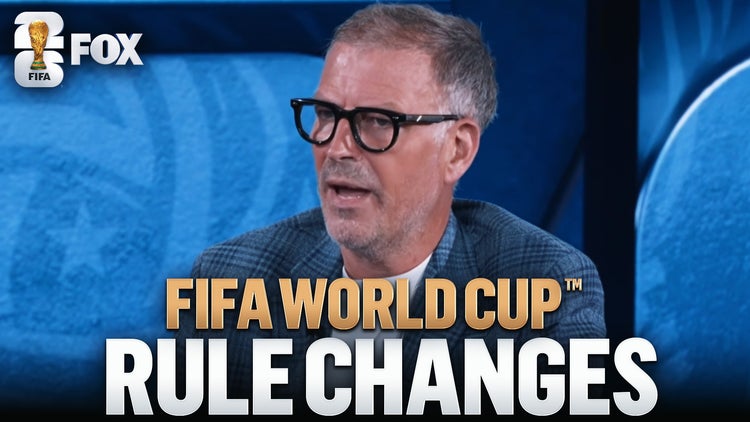
“What we have seen in this World Cup is — the game’s played in a better way, the game has flowed better,” FOX Sports rules analyst Mark Clattenburg said during the halftime show of Saturday’s match between Germany and Ivory Coast.
Clattenburg was an English Premier League official for more than a decade and is now a FOX Sports’ broadcaster, adding commentary to explain crucial referee decisions at the World Cup. Three of the main topics he’s alluded to include red-card assessment, time-wasting techniques and advancements to the video assistant review system.
All six red cards that have been given out at the 2026 FIFA World Cup have been straight red cards. Each was handed down because of physical contact, except for a recent one, which was assessed to Paraguay midfielder Miguel Almirón on Friday.
Almirón was penalized after covering his mouth while communicating with Türkiye’s Mert Müldür. The action might seem trivial, as Almirón didn’t physically impede Müldür, and it’s unclear what he said. But this is a direct example of a new infringement that leads to a red card in every scenario.
“What we saw was a situation that was very unsafe,” Clattenburg said. “We had a Champions League match between Benfica and Real Madrid, where FIFA and UEFA didn’t really like what happened when a player covered their mouth. So certainly they brought in a rule in April, and [it] was quickly implemented in this World Cup — that if a player does it in a confrontational way, they will be sent from the way of play.”
The original incident occurred on April 28 when SL Benfica’s Gianluca Prestianni said something to or about Madrid’s Vinícius Júnior. The Brazil star claimed Prestianni spewed racial slurs, but because he covered his mouth to disguise the message, it was unclear. To prevent that guessing game of wondering what a player said to their opponent in secrecy, FIFA targeted blocking one’s mouth when talking, specifically to an opponent.
Referee Ivan Barton issues a red card to Paraguay’s Miguel Almiron (not pictured) for covering his mouth while talking to a Türkiye player. (Photo by Stu Forster/Getty Images)
That discretion is important, as teammates or players and their coach can still address one another while blocking their mouths to keep from sharing game plans or tactics with opponents. But when it’s a player doing it to an opponent, a red card is awarded — as was seen with Almirón.
A few years ago, Clattenburg said, he “wanted the game to be speeded up.” That’s been addressed in multiple ways at the 2026 FIFA World Cup.
Players who appear hurt but remain in the match must wait a minute to return to the action as a way to deter faking injuries. Players who take too long to enter or leave the pitch when being substituted in or out will be kept off for a minute. When a goalkeeper takes too long to take a goal kick, it turns into a corner kick. Each of the time quantities are at the referees’ discretion.
Referee Ilgiz Tantashev officiated the Group C matchup between Scotland and Morocco. (Photo by Ulrik Pedersen/NurPhoto via Getty Images)
The U.S. was awarded the goal and went on to beat Australia, 2-0.
Referee decisions will continue to impact the outcome of matches at the 2026 FIFA World Cup. And it’s clear that FIFA has put time and effort into ensuring match-deciding scenarios can be reviewed for accuracy, players are rightfully punished, or not, and matches continue to flow.
Ultimate World Cup Rules Guide: Tiebreakers, VAR, Cooling Breaks And More
World Cup Red Cards: 2026 Has More Red Cards Than Each Of Last 2 World Cups