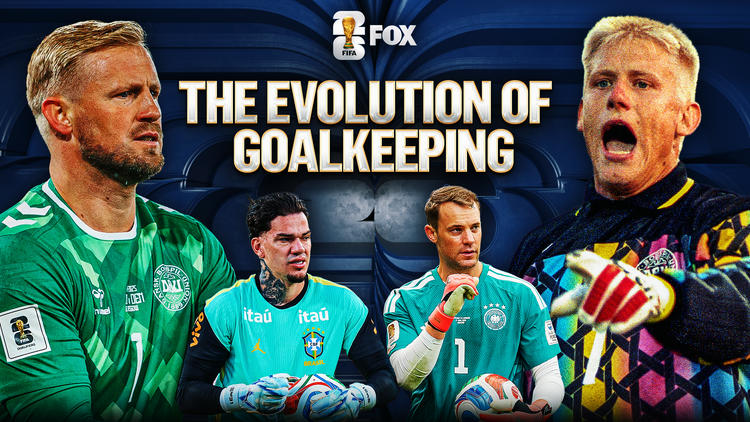
For Father’s Day, our resident goalkeeping father-son duo sat down to talk about the evolution of goalkeepers.
Both Kasper and Peter Schmeichel won the Premier League, and they both represented Denmark as the starting goalkeeper at their World Cups. They have seen it all and have been two of the best goalkeepers in the world during their respective eras. Normally, they keep their keeper talk with each other to their native Danish, but we were lucky enough to get them to go long in English.
During the 2026 World Cup, Peter, 62, and Kasper, 39, sat down and discussed many topics about their position on the pitch. Here is what stood out.
This conversation has been condensed and edited for clarity.
Peter: Growing up as a goalkeeper, we didn’t have gloves, so gloves came into the game around the time I became a senior player — 18 years of age. I got my first pair of gloves when I was 18. I did use garden gloves in the winter because it was cold, but they didn’t do anything other than keep you relatively warm.
That was a good thing because your catching technique was improved, and then, of course, gloves came in, and it was a little bit weird to begin with, and the quality of the gloves wasn’t great. You had to buy them yourself, relatively expensive, and then you know the foam started to wear off very, very quickly. You looked at this, you knew you couldn’t afford a new pair until six months later. So I opted a few times, even when I was a senior player, to play without gloves.
With the catching and all that — your basic technique was a lot better, but I like to throw the ball. So throwing the ball without gloves made it more accurate, and I could throw it longer. And then, of course, gloves came into the game, and the evolution of that improved, and of course, by the time I started to become a professional player, you couldn’t play without [them].
Peter Schmeichel celebrates winning the English Premier League with Kasper in May 1994. (John Peters/Manchester United via Getty Images)
Kasper: I would investigate exactly the altitude we were playing in. I’d see what type of pitch it was. I’d be going to the referees to make sure they watered the pitch. I’d be training with the ball for a long time beforehand. I’d make sure which gloves it was, because I took a pair of gloves out of the packet, and they were ready to go.
I use the Vaseline trick. So for people that don’t know, most goalkeepers these days — they’ll have Vaseline on their gloves because Vaseline dries it out a little bit, but it gives incredible grip on certain balls. This ball, the World Cup ball, it works great when it’s wet. It works great when it’s dry.
If you use a Premier League ball, it works great when it’s wet, not great when it’s dry. So, if you’re in a drier condition, you do one thing. If you’re in wet conditions, you do another thing.
Kasper: When you were with the national teams, that was when you had three coaches, and I actually found that I didn’t enjoy the three. I enjoyed it when we had a big group of goalkeepers, because I felt I could learn from others. I’d always watch and see what I could learn, but I felt we could make things more realistic.
I watched a lot of the stuff you did. It was very much repetition. You always talk to me about repetition, repetition, repetition, about catching. So, my pre-training work would be kicking the ball up against the wall, just catching, just practicing all the time so it became muscle memory.
Now, goalkeeper coaching has changed a lot. You’ve watched me train, I’ve watched you train, and it’s slightly different. So, how was it different when you played?
Kasper Schmeichel and Denmark were eliminated in the round of 16 at the 2018 World Cup. (Richard Heathcote/Getty Images)
For a couple of years, I tried to persuade [former Manchester United manager] Alex Ferguson to sign him, because I saw him, and I wanted somebody to continue what I did. I felt it was really important that we had somebody who could do the same things: control the box, get the team to play higher up the pitch, find those channels [going forward] when need be. And he had this young lad here, absolutely fantastic.
Ederson is taking playing with your feet to the next level. I’ve never seen anything like that.
Kasper: For me, it was always about control. We actually used a mentalist, a guy that guesses things that you’re thinking, but they’re putting it in your head. So, we actually asked one of those to see what we can actually do to influence a taker, and it would be things like over emphasizing certain words. In a VAR situation when the referee is out checking, I had a chance to talk to the taker. I’d overemphasize words like over or right or left, or try to do different things that they kind of taught us to look for. Can I get some kind of influence?
We had faced a penalty against Peru in the World Cup 2018. I kept overemphasizing the word over, “Don’t hit this over,” all these kinds of things, emphasizing the word over. Whether it made a difference, I don’t know.
But by the way, yeah, the ball is still going.
Kasper Schmeichel celebrates Christian Cueva’s penalty miss against Denmark at the 2018 World Cup. (Elsa/Getty Images)
And I don’t think, at the moment, in the Premier League, there’s anyone better than Donnarumma. It doesn’t look like you know he’s got it under control, but trust me, he has. He gets out there for every ball, and he just punches it away, big, strong. …
Now, when everyone [is] focusing so much on set pieces, I think it becomes more important that a goalkeeper can actually come out and punch the ball or catch it. And I think because of the other thing you said, are we going to see more long balls? I think we’re going to see a lot more direct play, as we’ve already seen in this World Cup, which I really, really do welcome.