U.S. World Cup Training Base (Irvine, Calif.) — One of the biggest story lines entering — and now during — the 2026 FIFA World Cup has been the added wrinkle of mandatory hydration breaks.
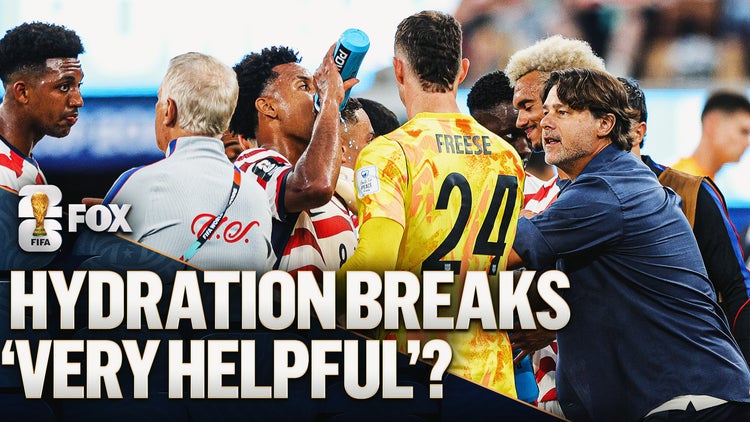
Rather than playing two uninterrupted 45-minute halves, FIFA has introduced a brief three-minute cooling period midway through each half, effectively dividing matches into quarters. The measure is intended to protect players from extreme summer heat, with temperatures in some host cities expected to exceed 100 degrees Fahrenheit. Many World Cup sites, however, are equipped with roofs and climate-control features designed to help mitigate those conditions.
The topic has generated debate for months. Some players and coaches agree that water breaks aren’t needed in enclosed stadiums where conditions are more manageable, but they acknowledge it’s a different story in open-air venues.
The U.S. men’s national team won its first two World Cup matches — against Paraguay and Australia — and has already clinched first place in Group D. The Americans face Türkiye on Thursday in Los Angeles, but the result doesn’t matter because they are already booked to play in the round of 32 on July 1 in Santa Clara, California.
(Photo by Jane Gershovich/ISI Photos/ISI Photos via Getty Images)
The USA’s first match at Los Angeles Stadium was mostly enclosed with an evening kickoff time, while Seattle Stadium was open for the midday game. Even so, the players are pretty unfazed by the addition of water breaks.
“I’m pretty indifferent towards it,” starting goalkeeper Matt Freese told reporters on Tuesday. “I’ve done it before in MLS, so it’s not too new for me.”
The hoopla surrounding the breaks intensified during the USA’s pre-World Cup tune-ups. When the squad played Senegal in Charlotte a few weeks ago, manager Mauricio Pochettino pulled out a laptop during the hydration break to review tactics, using the time to his advantage. The broadcast hilariously captured the moment as players huddled around Pochettino, listening while he outlined adjustments and tweaks.
“I think it’s very helpful for the players to see actions,” Pochettino said after that match. “It’s not only to tell what you want [them] to improve, or what they need to do. When they see the image, it’s really important now.”
Pochettino acknowledged then that it was “unusual” to have a helpful prop such as a laptop at his disposal in the middle of a game, but then claimed he was the first coach to do it while managing Espanyol from 2009-12.
Pochettino has continued to use the laptop during the World Cup.
“Yeah, sometimes [the coaches] just change the tactics or whatever if they see things are not going well in our way,” Sergino Dest told reporters last week ahead of the Australia match. “I think it’s nice to have a hydration break. It’s also [a chance] to kind of settle and talk with your teammates. It can be nice.”
(Photo by Alex Grimm/Getty Images)
Other managers have voiced criticisms as well. But regardless of any backlash, water breaks in international soccer could be here to stay. FIFA president Gianni Infantino said Tuesday that they will decide what to do in future tournaments “based on this experience.”
“Maybe the coach can reassess certain situations, correct certain mistakes,” Infantino told SNTV. “The players get a little rest and come back in full speed. Well, is that bad, necessarily? Maybe it’s good. And we see as well the intensity of the games. We’ve never seen 90 minutes in a tournament like this played in such an intensity.
“Until the last second of the match, players attack and so on. And maybe — maybe not — but maybe it’s also a bit thanks to this little break the players have, and after they can go back on the field and show what they can do.”
This conversation will likely continue even after the World Cup final. But as far as U.S. players are concerned, it’s no big deal.