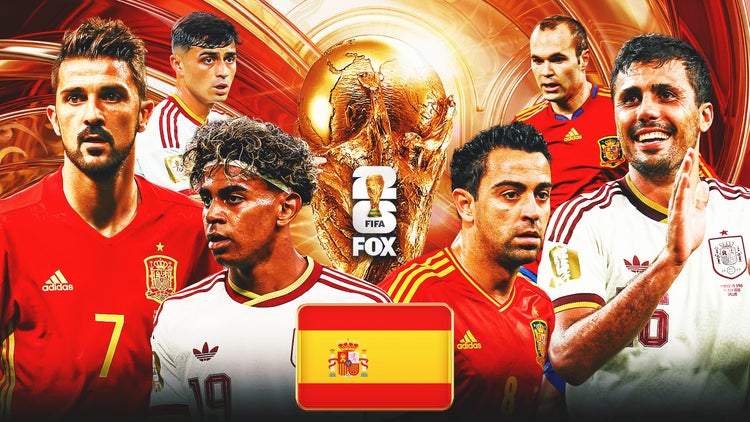
Spain winning the 2026 FIFA World Cup puts this generation in the conversation with some of the greatest national teams in history.
No team had followed a European Championship title with a World Cup victory since Spain did it by winning Euro 2008 and the 2010 World Cup. That legendary Spanish side then completed an unprecedented three-peat by winning Euro 2012.
Those Spain teams are widely recognized among the greatest national sides in football history. But this current generation is starting to make its own case and will enter Euro 2028 with an opportunity to match that historic run of three consecutive major tournament titles.
Let’s make a combined XI between Spain’s 2026 and 2010 World Cup-winning teams.
(Photo by Eric Verhoeven/Soccrates/Getty Images)
Both goalkeepers had incredible tournaments and earned the Golden Glove.
Simón made history with seven clean sheets, the most by a goalkeeper at a single World Cup. He also conceded only one goal throughout Spain’s entire campaign, the fewest ever allowed by a World Cup-winning team.
Casillas gets the nod because of his overall pedigree and because he was simply the better goalkeeper at his peak. He conceded only two goals in 2010, kept five clean sheets and made one of the biggest saves in World Cup final history when he denied Arjen Robben with his outstretched foot.
Simón had the better statistical campaign, but Casillas remains Spain’s greatest goalkeeper.
Verdict: Iker Casillas
(Photo by Evrim Aydin/Anadolu via Getty Images)
Cubarsí winning the World Cup as a teenager while starting at center back is a remarkable story. His composure and ability to play out from the back were critical to a Spanish team that conceded only one goal.
But Puyol was the true leader of Spain’s 2010 side, anchoring the back line with his physicality, commitment and defensive awareness. He also scored the decisive header against Germany in the semifinal to send Spain to its first World Cup final.
Cubarsí may eventually build a legendary career of his own, but Puyol gets the clear nod here.
Verdict: Carles Puyol
(Photo by MIGUEL RIOPA / AFP via Getty Images)
Porro had a strong World Cup, providing value on both sides of the ball and scoring Spain’s second goal in the 2-0 semifinal victory over France.
But Ramos gets the nod as one of the defensive cornerstones of Spain’s golden generation. He was defensively reliable while also offering tremendous value going forward.
Ramos remarkably completed 31 dribbles at the 2010 World Cup, more than any other player in the tournament, despite playing at right back.
Porro had a great campaign, but this one belongs to Ramos.
Verdict: Sergio Ramos
(Photo by Justin Setterfield/Getty Images)
Fabián gave Spain a different profile after Luis de la Fuente introduced him into the starting lineup during the knockout stage. His ability to carry the ball forward and cover ground next to Rodri added more dynamism to the midfield.
But Busquets gets the clear nod.
Like Rodri for the 2026 side, Busquets served as the metronome for Spain in 2010. He dictated the tempo, protected the defense and played with composure far beyond his years during his first major international tournament.
Busquets allowed Xavi and Iniesta to play with more freedom and was one of the most important tactical pieces in Spain’s success.
Verdict: Sergio Busquets
(Photo by Clive Rose/Getty Images)
Baena had a solid tournament and played an important role on Spain’s left side, giving the team the ability to keep possession, drift into different pockets and connect play in the final third.
But Iniesta is a player you have to make room for in this team, even if he did not operate as a traditional left winger throughout the 2010 World Cup.
His technical ability, creativity and capacity to progress the ball made him one of the best players of his generation. He also scored the most important goal in Spanish football history, delivering the extra-time winner against the Netherlands in the 2010 final.
Iniesta makes any combined XI in which he is an option.
Verdict: Andrés Iniesta
(Photo by Alex Livesey – FIFA/FIFA via Getty Images)
Yamal gets the nod after winning a World Cup as a teenager.
He entered the tournament recovering from a hamstring injury and did not control every match in the way he might have wanted, scoring only one goal. But he steadily grew into the competition and remained one of Spain’s most dangerous creative players.
Pedro became an important part of the 2010 side late in the tournament, earning starts in the semifinal and final because of his energy, pressing and intelligent movement.
But Yamal’s ceiling, talent and importance to this 2026 team give him the edge.
At only 19, Yamal already has a European Championship, a World Cup and multiple club trophies. He has built the foundation for what could become a phenomenal career.
Verdict: Lamine Yamal
Formation: 4-2-3-1
GK: Iker Casillas
RB: Sergio Ramos
CB: Carles Puyol
CB: Gerard Piqué
LB: Marc Cucurella
CM: Rodri
CM: Sergio Busquets
CAM: Xavi
RW: Lamine Yamal
LW: Andrés Iniesta
ST: David Villa