
NEW YORK NEW JERSEY STADIUM — I’ve often joked that ranking World Cups is like choosing between your children: They’re all different and unique. You don’t love one above another. It just doesn’t work that way.
The 2026 FIFA World Cup was the sixth, men’s or women’s, that I’ve had the privilege of covering.
The first five took me to Brazil, Canada, France, Qatar, Australia and New Zealand. Each was incredibly special. Years earlier, as a young professional, I hoped to cover one, one day, if I worked my ass off and maybe got a bit lucky. Until this summer, I couldn’t have picked a favorite if my life depended on it.
But a home World Cup like this summer’s? That was a new experience for me, just like it was for most of my colleagues.
The feeling is hard to describe. We all went into it knowing full well that it’s probably a once-in-a-career thing.
Now the biggest, most spectacular World Cup of all time is over. And as I sit here typing in a mostly empty 80,000-seat arena after Spain beat Argentina in Sunday’s final, watching La Roja’s players on the field below me celebrate their well-deserved triumph with their families, I’m filled with gratitude — and maybe a little sadness, too.
Part of that is exhaustion, having been on the road and away from my family for almost two full months. That will subside. The memories won’t:
The way the United States men’s national team ran out to an early lead against Paraguay in the first World Cup match on U.S. soil in 32 years, then ran away with the match en route to a historic 4-1 victory that captured the imagination of the American public. How the upper deck at Seattle Stadium began vibrating when VAR awarded Alex Freeman’s goal in the USA’s 2-0 win over Australia, the first time the U.S. had ever won two straight World Cup games.
I was in Los Angeles to witness Canada, led by American coach Jesse Marsch, win a World Cup knockout game for the first time in that country’s history.
A couple of days later, in the San Francisco Bay Area, Mauricio Pochettino’s 10-man U.S. squad not only survived a red card against Bosnia and Herzegovina but actually padded its lead on the way to a 2-0 win — just the second knockout victory in this country’s history, even if it came in the new round of 32.
Unfortunately, that was as good as it got for the World Cup co-hosts.
By the time you read this, it will have been more than two weeks since Pochettino’s team squandered an incredibly rare opportunity with 50 million in the U.S. watching live, getting embarrassed, 4-1, by Belgium, even after striker Folarin Balogun was controversially allowed to play by FIFA despite the red card he received against the Bosnians.
It’s still difficult to understand how the home team, playing in front of another incredible crowd up in Seattle, was so unprepared for that game and so unable to find a way back when things started to go so horribly wrong, despite having the most decorated and handsomely paid coach it’s ever had. It was the largest margin of defeat the U.S. has suffered in a World Cup knockout match since 1934 and will probably remain so for decades.
Yet despite the ugly loss, the Americans surely won millions of new fans this summer.
For other countries, the World Cup continued.
I was fortunate enough to see England and Norway’s hard-fought quarterfinal in Miami, and while the battle between the sport’s two most lethal pure center forwards — Harry Kane and Erling Haaland — didn’t materialize, it was a treat to watch Jude Bellingham steal the show with both of the Three Lions’ goals in a 2-1, extra-time win.
That night, writing in a hotel lobby between bites of a Cuban sandwich, I was struck by England’s fans cheering for Switzerland as passionately as they had for their own team hours earlier.
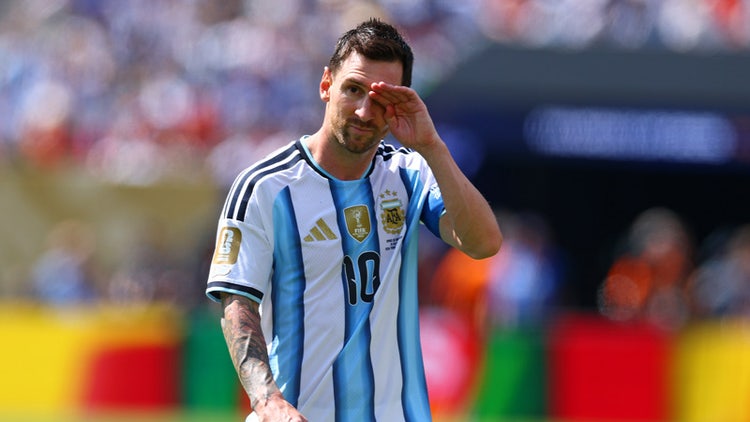
They wanted no part of Lionel Messi and Argentina, one confirmed. That fear soon proved justified.
For me, the highlight of this World Cup came in England’s next match. Say what you will about Thomas Tuchel’s tactics after his Three Lions took a 1-0 lead over the defending champions, but watching La Albiceleste claw back two goals in the last five minutes, plus stoppage time, with the incomparable Messi setting up both, is not something I’ll ever forget.
And not just because an Argentine journalist sitting to my right in the press box — where merely applauding politely is usually forbidden — removed his shirt and began swinging it around his head in celebration. On the streets of Atlanta afterward, one comically inebriated English fan challenged every Argentine he saw to a fistfight. Fortunately for him, all were too drunk on victory to oblige.
Which takes us to Sunday’s grand finale.
If every World Cup tournament is special, the final is on another level still. While Sunday’s didn’t match the drama of the 2022 decider I saw in Lusail, Qatar on Dec. 18, 2022 (no, I didn’t have to look up the date), there’s always this cosmic energy surrounding the title bout. You know more than a billion people across the globe are tuned in, that history is being written in real time before your very eyes.
I can vividly recall where I watched every final since I caught the soccer bug as a kid. Getting to work the last two men’s versions in person is an immense privilege, an aspirational milestone everyone in this business works toward for years or sometimes decades before finally getting there — if they ever do.
For someone raised in New York City, Sunday was the ultimate full-circle moment.
In my early 20s, I covered MLS games across the parking lot at the old Giants Stadium. A decade before that, on a similarly sunny, sticky summer afternoon in 1994, I saw my first World Cup game in the same building, with my father.
Soccer in mainstream America was a curiosity then. As these 39 days have proven, this is a soccer country now. Although I hope to cover more World Cups in the future, this one will be impossible to top.
That’s the magic of the World Cup. It’s the memories that make them great.