
Maybe the U.S. men’s soccer team’s so-called “Golden Generation” never stood a chance.
There’s been plenty of theories about why the USA, with a collection of in-their-prime players who star for some of the planet’s leading clubs and who thrilled fans en-route to the round of 16 at this summer’s World Cup, fell flat against Belgium and bowed out at the same stage as the last three American squads to participate in the tournament despite this one being played on home turf.
Maybe it was just a bad game. Maybe they just weren’t good enough. Maybe the “target” that defender Chris Richards recently admitted was plastered on their backs when FIFA rescinded Folarin Balogun’s suspension was just too big to shake.
The USA finished the 2026 World Cup with a round of 16 exit. (Photo by Charlotte Wilson/Getty Images)
Or maybe it was the result of a combination of factors.
Here’s one more to consider.
When the USA shockingly failed to qualify for the 2018 World Cup, they were caught between two generations, the consequence of a problem FOX Sports contributor Brian Sciaretta identified even before that fateful loss in 2017 to Trinidad & Tobago: A “black hole of development” among players born between 1990 and 1996.
During the 2018 cycle, the old guys were too old. Besides teenage star Christian Pulisic, youngsters like Tyler Adams and Weston McKennie were too young.
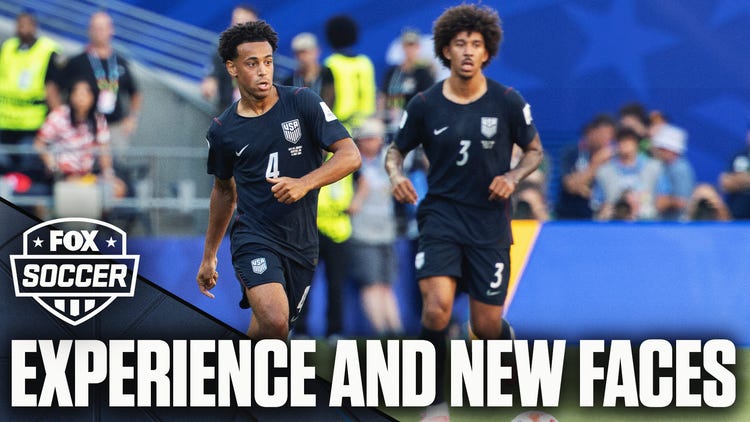
Weston McKennie and Tyler Adams are now mentoring the next generation. (Photo by Sarah Stier – FIFA/FIFA via Getty Images)
Still just 27, Adams has already played in two World Cups and made more than 250 club appearances in the Premier League, the UEFA Champions League, Germany’s Bundesliga and MLS. Even with AC Milan’s Pulisic and Juventus’ McKennie out for these upcoming four home friendlies (the U.S. will also take on Chile, Mexico and Canada) after having just returned from early season injuries in Italy, the current group is significantly more grizzled than the one Adams and Richards joined as international neophytes.
“Make sure that they know that they still have to earn a spot,” said Richards when asked what the integration process looks like internally. “Just because you’re here, it’s not the finish line. It’s the starting point.
“But when it comes to off the field stuff,” added Richards, who on Wednesday led the national team’s longtime initiation ritual that requires first-time callups to sing in the meal room, “it’s just making sure that they also feel welcome in this environment.”
Chris Richards and Sergiño Dest are on a roster that mixes youth and experience. (Jane Gershovich/ISI Photos/ISI Photos via Getty Images)
That’s a luxury he, Adams and the rest of the USA mainstays simply didn’t have.
“When I came in, it was off the cusp of obviously not qualifying for a World Cup, and it was like you guys basically need to play right now and need to perform right now so that we can qualify for the next World Cup,” said Adams, who at 23 was the youngest captain in Qatar.
“There’s less pressure on these young kids to come in and perform immediately, and more time to be able to actually develop them,” he continued. “I look at this generation of players right now, and I think they’re in a great position to be able to go through the process properly.”