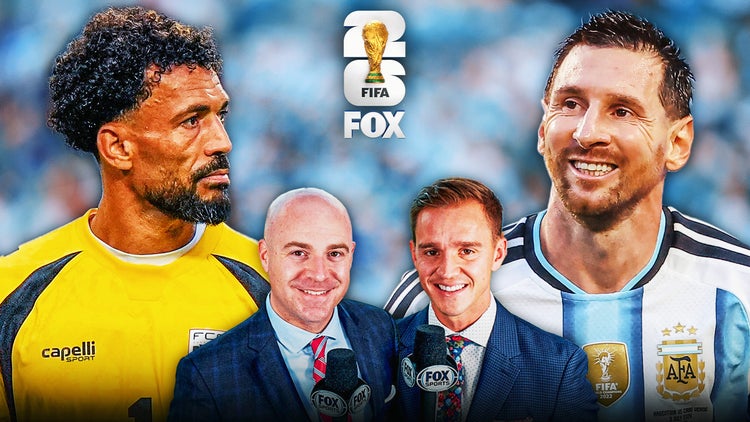
Was this going to be Lionel Messi’s final World Cup game?
That was a thought that entered both John Strong’s and Stu Holden’s minds as they braced themselves for history while calling the epic round of 32 matchup between Argentina and Cape Verde on Friday in Miami.
Cape Verde pushed the reigning champions to the brink of a penalty shootout before Argentina ultimately pulled off the 3-2 victory in extra time. It was an all-time thriller and showcased what both Strong and Holden describe as the “true beauty of the World Cup.”
“Even beyond my expectations, they performed at a level that will be remembered for years,” Holden said of the debutant Blue Sharks. “I think that’s why this game has become such a talking point.”
(Photo by Wu Zhizhao/VCG via Getty Images)
Saturday, we caught up with Holden and Strong — who were in a car together on their way to the France-Paraguay match — to discuss their perspectives on the game, its place in history and how they approached the match broadcast.
This interview has been condensed and edited for clarity.
Holden: No, it just came out in the moment. I think over the years, John and I have done a lot of these types of games where you have the underdog story. We take a lot of pride in being able to tell their stories and, I think, not just focusing on the big team in those matchups.
Last night was just one of those games where both of us are just kind of looking at each other and laughing and smiling and just enjoying what was an incredible moment on the field and captivated by the story. I think we try to convey with our words and our emotions and our inflections and calls of what we’re experiencing, so that was kind of just genuine from the heart.
Holden: It goes back to even the first game against Spain — and John and I talk about this a lot — just being ready for the unexpected. … We recognize, too, that these moments are once in a lifetime for these players, and it’s our responsibility, I think, to tell the world about these players’ stories and especially the American audience, who won’t have a clue. It makes people care, and it makes people more invested about what the game actually means. So that’s something we take great pride in.
Strong: It’s not just about, OK, this is Argentina’s inexorable march. It’s, what if? And being prepared for that, and if it doesn’t come off, and if Argentina wins the game comfortably, then OK, fine. But that’s something, as Stu said, we take an immense amount of pride in.
I think that’s a mark of professionalism, is being prepared for all the eventualities. What if the left back scores an incredible goal? What if, multiple times, Cape Verde is coming from behind? All of those sorts of things, just being prepared. But then also reacting in the moment, and, I think, not getting caught in the trap of, well, this is how this game is supposed to play out, so we’re just going to prepare for that, and allowing yourself to come in with a bit of a blank slate, be surprised, be amazed. Yes, give context to the fact that it is remarkable what Cape Verde is doing without disrespecting them by being bewildered by it, and not having any context to give on what they do.
(Photo by Chris Arjoon/Icon Sportswire via Getty Images)
Strong: We’re doing it live on television. At one point, I think we were both giggling. That’s the thing: We don’t hide our genuine emotion in the moment.
Holden: But yes, we’re constantly in sync in those ways, but we’re matching each other’s energy. I just kept saying how much I love this game because I felt fortunate to be in that moment in that stadium, experiencing that, being on the call for that, being wrapped up in the emotion of it.
(Photo by Eva Marie Uzcategui – FIFA/FIFA via Getty Images)
Strong: That was my lede into kickoff, was it could be his last. You’re always mindful of that, you’re always aware. We’ve done three World Cups. We’ve done a lot of these types of games where things become unexpected. We’re very experienced, thankfully, in these moments.
It would be disingenuous to sit here and say, “Oh, we knew that was going to happen.” But I think it would also be us not doing our jobs if we were completely bewildered and taken by surprise and unprepared for that eventuality. And for that matter, we were fully prepared, as we always are, for if it goes into a penalty shootout. That’s that’s what we do. That’s our job. That’s what it requires, and you just then hold on for dear life and follow the game where it takes you.
Holden: John nailed it, and it’s something we talked about even in the World Cup final. I’ve heard him give this speech at broadcast journalism schools. You have to be willing within the game to throw all your notes, what you’d prepare for, out the window. And I think that’s the case where, in the late stages of that game, we’re not relying on our notes. We’re just relying and reacting on what’s happening. And, of course, we have stats and superlatives and different things, but we’re more so just being fans at that moment and taking the viewers along for a ride and living in it.
(Photo by Luciano Bisbal/Eurasia Sport Images/Getty Images)
Strong: That’s the power of the World Cup, first of all. He could have had a wonderful performance in a league game in the Portuguese second tier, and no one would have noticed. You put together a great performance in the World Cup, and it changes your life. I think it also, again, comes back to not just our preparation, but our approach in general to these games is to not fall in the trap of, “Oh, this guy doesn’t play for a big-time European club. Oh, this guy isn’t already a big star, so we’re not going to worry about him, and we’re not going to worry about his story and his background, and we’re not going to be prepared to celebrate him.”
You need to be prepared for any player on the field to be the star. And he did that in that first game against Spain. You assume when you’re playing Messi and when you’re playing Argentina, you’re going to have to come up with a couple big moments when you’re a goalkeeper. So that’s what’s very fun, is to try to, even if I’m not launching into a very long soliloquy about his whole life story, just to be able to celebrate his performance and celebrate him.
Holden: We talk about these players who get on this big stage that they can normally get moves into big clubs or change their transfer value. For a 40-year-old goalkeeper, the moves are probably not there. So he has, in fact, changed his entire life commercially, sponsorship wise. He’s going to make a lot of money off this tournament, and I just think that that’s awesome for a guy who’s pretty much a journeyman and was previously not known around the world and has become this viral sensation, and that is, as John said, the true beauty of the World Cup.
Strong: Oh, for sure. Until the next one.
Holden: Until the next one. But that’s our challenge, honestly. We have all these amazing games, and yet, now we’ve got to turn around much like players would, in essence, and just move on to the next one. And I think we’ll have much more time after these [games] are done to process and enjoy what it was.
But we are trying to live in the moment and recognize when we see brilliance, because you still have to have that wonderment and to be able to convey that. But if we act like we’ve seen it before and that we aren’t understanding what that is, then we’re not going to convey that genuine type of emotion like we did [Friday] night.