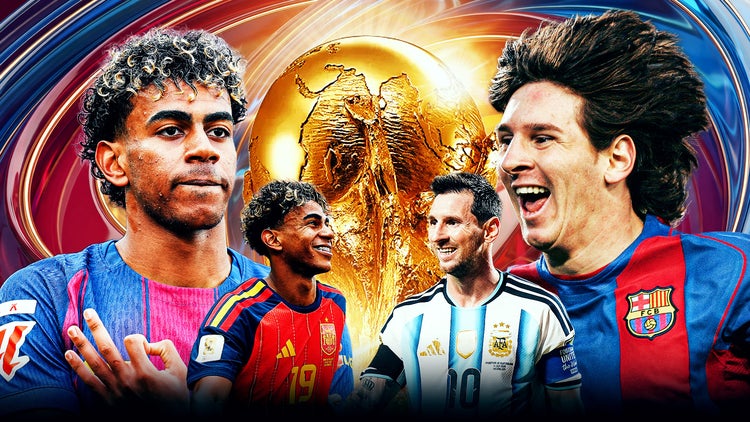
Twenty-six years ago, when a 13-year-old Lionel Messi left his beloved Rosario and arrived in Barcelona for his trial to join La Masia academy, with the hopes of sealing a move that could change his life, no one could predict how that moment would not only eternally change Messi’s life or the footballing landscape as a whole, but it would also create a butterfly effect that would transform the entire fate of a club, a nation and the way Messi and Barcelona became the greatest partnership in modern football history.
But his departure in 2021 from the club, which sent shock waves around the world, caused a seismic impact on so many tangible factors that forced Barcelona to act.
As a result, from a fatalistic standpoint — Messi’s departure from Barcelona and his eventual arrival to Inter Miami after a disappointing tenure with PSG, would become a huge factor in what we are currently witnessing, which is the continued gritty dominance of Argentina and the jaw-dropping depth of Spain, including the rapid rise of its star player, Lamine Yamal.
Sunday’s World Cup final, therefore, has a chapter deeply embedded in its theme — and that’s the role of Barcelona.
(Photo by Eric Alonso/Getty Images)
Messi’s exit from the club was a result of financial instability and terrible mismanagement, where the club’s huge debt impeded it from signing the superstar due to La Liga’s financial fairness regulations. After 21 years, with heavy emotion, Messi left the club and joined PSG.
As a result, through the years, Barcelona needed to make the best of its most important asset: the aforementioned academy as La Masia, the place who nurtured Messi, would have to come to the rescue once again.
Since Messi’s departure, at least 15 different graduates from La Masia have featured heavily for Barcelona, including Lamine Yamal, who made his arrival to the senior team in the 2022/2023 season under then-manager Xavi.
Yamal aside, this acceleration of the young Spanish talents now infiltrates La Roja with the likes of Pedri, Gavi, Pau Cubarsí, Eric García and Dani Olmo are all very important for the national team and a reason why Spain’s dominance has catapulted.
(Photo by Ian MacNicol/Getty Images)
And his departure from Barcelona also helped Argentina because after PSG, winning the World Cup in 2022 was a sign of resilience and fortitude. But it was also about reflection.
So his arrival to Inter Miami six months later gave him something that can’t be measured in transfer or contract fees. It gave him his happiness.
“I have never seen you happier,” I told him the night before the Leagues Cup final, which would become Inter Miami’s first ever trophy. “It’s true,” he smiled back. “Not just because of results on the pitch but because of our everyday lifestyle, with my wife, my kids and the way we spend our time.”
Yes, we would have to be fools to not realize that his move to MLS was financially monumental in every way, but it was also about his everyday life and his acceptance of peace after leaving PSG. Messi, once again, was happy. Calm.
And I think this allowed him to continue playing and eventually winning MLS Cup but also, creating an even stronger relationship with Argentina, the players, Lionel Scaloni and its community. Miami, you see, and the South Florida region, is home to the largest Argentinian diaspora in America. Messi is practically in Rosario without actually being there. His people are there. Argentina’s federation even has a base in Miami, with a complex, offices and also work closely with Inter Miami for Messi’s preparations prior to major matches and tournaments with the national team.
So playing in America throughout this World Cup has truly served Messi and Argentina. If this is his last dance, it is being played to a beautiful tango of Argentinian warmth.
(Photo by Rich Storry/Getty Images)