
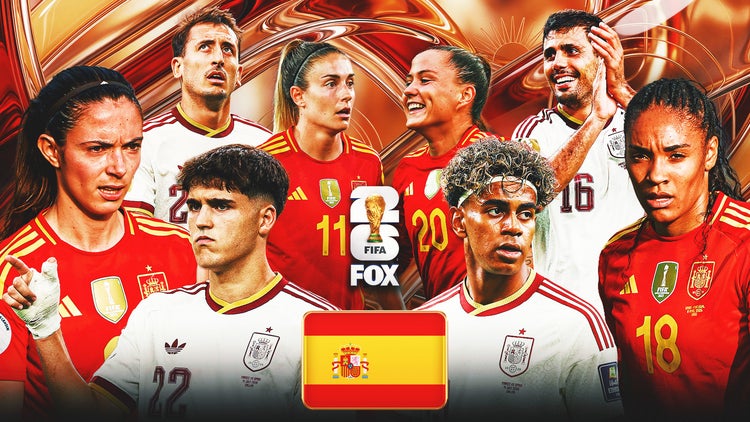
NEW YORK — Spain has the chance to accomplish something no nation has ever achieved.
If it defeats defending champion Argentina in Sunday’s World Cup final, both its men’s and women’s national teams will simultaneously hold the sport’s biggest trophy, which no country has ever done before.
Germany’s men and women have each won two World Cups, but never concurrently. Similar feats have happened in other sports, including UConn’s men’s and women’s basketball teams winning national championships in 2004 and 2014, USA Basketball’s men and women taking gold at the 2024 Paris Olympics and the American men’s and women’s hockey teams winning gold at the 2026 Milan-Cortina Olympics.
Now Spain — with the women’s side winning its first World Cup title in 2023 — has a chance to set a new standard for sustained dominance on soccer’s biggest stage.
Spain celebrating after winning the 2023 World Cup. (Photo by Li Yibo/Xinhua via Getty Images)
So how did Spain get here? What has allowed it to separate itself from the rest of the world? What is it doing better than everyone else?
“This is the only country that starts a philosophy and an identity at a young age, and they’re all doing the same things from 9 years old and up, both the men’s and women’s side,” U.S. women’s national team legend Carli Lloyd told me. Now a FOX Sports analyst, Lloyd played against Spain during her career and has watched firsthand how the program evolved into a powerhouse.
“They focus on technical excellence first and their positional play, short passing, patience, development — all those different things. And I think for a number of years, they weren’t incredibly successful but have figured out ways of going about that with the way they play.”
The World Cup is only part of the story. Spain’s superiority has extended across nearly every major competition. The women’s national team won the 2025 Euros, while Barcelona — the club that is essentially the backbone of the squad — has captured three of the last four Women’s Champions League titles.
The men’s team enters Sunday’s final as the reigning European champion and Olympic gold medalist. Twenty of the 26 players on Spain’s World Cup roster were part of one or both of those triumphs, evidence that this success has been building for years.
For many of these players, the foundation was laid years ago at La Masia, Barcelona’s famed academy that has long been considered one of the world’s best at developing young talent. It’s where Lionel Messi arrived as a 13-year-old before becoming arguably the greatest player in history.
The academy’s legacy extends beyond Messi, though. Nine alumni will be on the field for Sunday’s World Cup final: Messi for Argentina and Lamine Yamal, Gavi, Pau Cubarsí, Dani Olmo, Alejandro Grimaldo, Marc Cucurella and Víctor Muñoz for Spain. The viral photo of Messi bathing baby Yamal has become a symbol of the passing of the torch, but a deeper connection is that both were shaped by the same developmental system.
The academy opened its doors to women residents in 2021, and its pipeline has already produced many of Spain’s biggest stars, including three-time Ballon d’Or winner Aitana Bonmatí, two-time winner Alexia Putellas, Clàudia Pina, Ona Batlle and more.
Aitana Bonmatí during the 2023 FIFA World Cup final against England in Sydney, Australia. (Photo by Jose Breton/Pics Action/NurPhoto via Getty Images)